Posts

Showing posts with the label NiCd

NiCd Battery Charger

Image
This NiCd battery charger can charge up to 8 NiCd cells connected in series. This number can be increased if the power supply is increased by 1.65v for each additional cell. If the BD679 is mounted on a good heatsink, the input voltage can be increased to a maximum of 25v. The circuit does not discharge the battery if the charger is disconnected from the power supply. Circuit diagram: NiCd Battery Charger Circuit Diagram Usually NiCd cells must be charged at the 14 hour rate. This is a charging current of 10% of the capacity of the cell for 14 hours. This applies to a nearly flat cell. For example, a 600 mAh cell is charged at 60mA for 14 hours. If the charging current is too high it will damage the cell. The level of charging current is controlled by the 1k pot from 0mA to 600mA. The BC557 is turned on when NiCd cells are connected with the right polarity. If you cannot obtain a BD679, replace it with any NPN medium power Darlington transistor having a minimum voltage of 30v and a c...
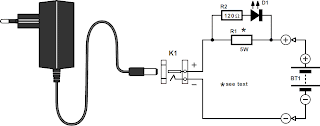
Simple NiCd Battery Charger

Image
The design of the charger is similar to that of many commercially available chargers. The charger consists of a mains adaptor, two resistors and a light-emitting diode (LED). In practical use, this kind of charger is perfectly all right. Resistor R1 serves two functions: it establishes the correct charging current and it drops sufficient voltage to light the diode. This means that the LED lights only when a charging current flows into the battery. The charging current is about 1/4 of the battery capacity, which allows a slight overcharging, and yet the charging cycle is not too long (4–5 hours). Simple NiCd Battery Charger  Circuit diagram:   The value of the resistors may be calculated as follows, for which the nominal e.m.f. and the capacity of the battery must be known. Adjust the output of the mains adaptor to 1.17 times the nominal battery voltage plus 3.3 V, which is the potential across R1. Note that the adaptor must be capable of supplying a current of not less than ha...